Fez Morocco is not a city you visit — it’s a city you survive, in the best possible way. I spent two days there in spring, staying with my friend Rachid, who’s lived near the medina long enough to know its shortcuts — and I still got lost more times than I can count. That’s Fez for you.
If Marrakech is Morocco’s showpiece and Chefchaouen is its postcard, Fez is its beating, chaotic, unfiltered heart. It’s the oldest of Morocco’s four imperial cities, founded in the 9th century, and unlike some historic sites that feel preserved behind glass, Fez el-Bali (the old medina) is genuinely alive — people still live, work, and trade exactly where their ancestors did centuries ago.
Fez el-Bali: The Medina That Never Stops Moving
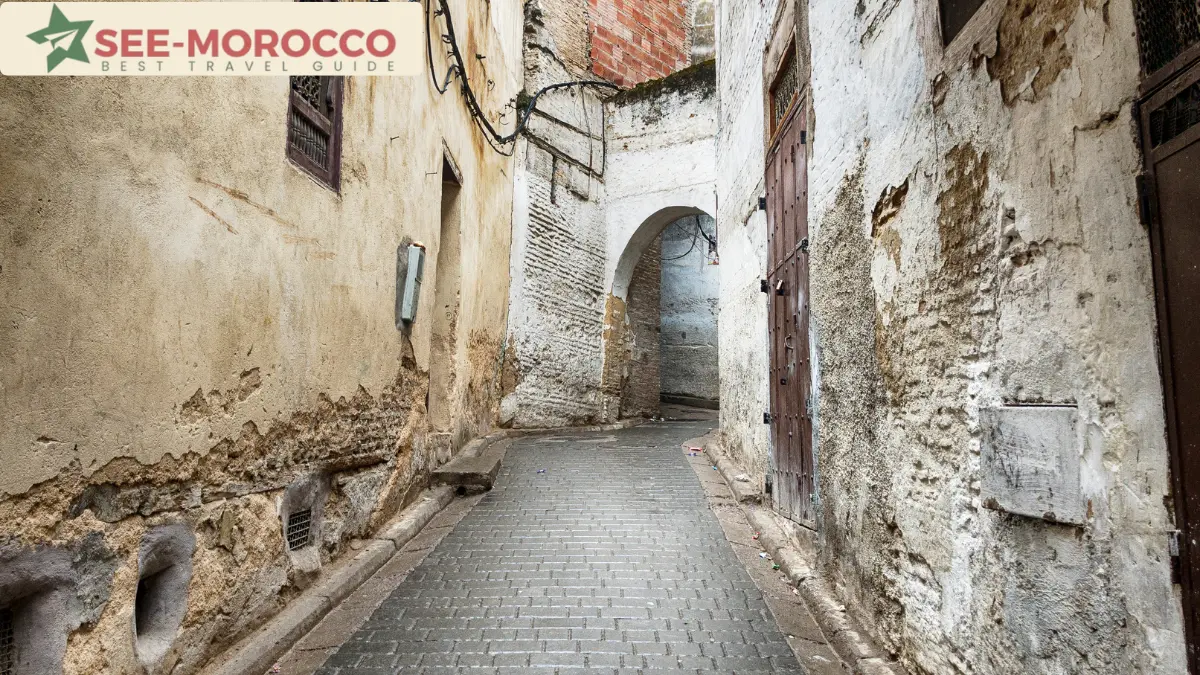
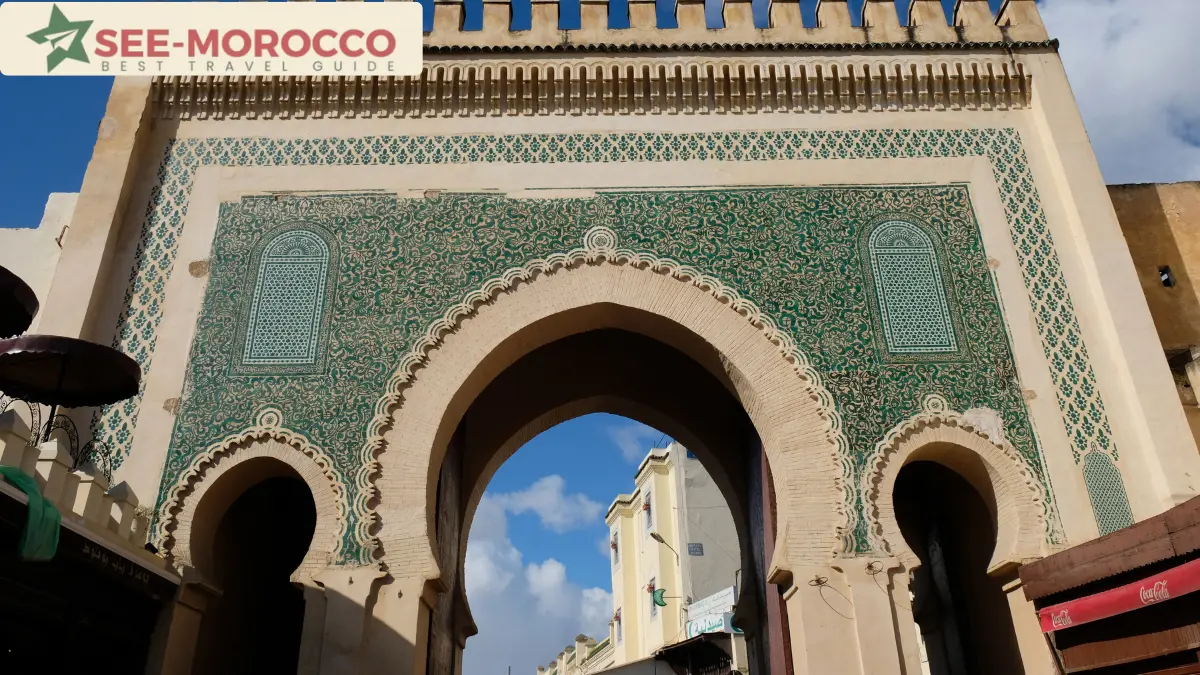
Fez el-Bali is one of the largest car-free urban zones in the world, and within minutes of walking through Bab Boujloud — the famous blue-and-green tiled gate that marks the medina’s main entrance — you understand why cars would be pointless here anyway. The alleys are barely wide enough for two people to pass, let alone a vehicle. Everything moves by foot, handcart, or donkey, and you learn quickly to press yourself against a wall the moment someone shouts “Balak!” (watch out) from behind.
Rachid and I spent almost a full day just wandering, and “wandering” is really the only strategy that works in Fez. Trying to navigate by map is mostly a losing battle — the medina has over 9,000 alleyways, and even locals sometimes take a wrong turn. My honest advice: budget extra time, expect to get turned around, and don’t fight it. Getting lost in Fez is part of the experience, not a failure of it.
What struck me most walking through Fez el-Bali wasn’t any single landmark — it was the density of daily life packed into such a small space. Metalworkers hammering trays a few steps from spice vendors, who are a few steps from a bakery sliding round loaves into a communal oven, who are steps from a workshop stitching leather babouches by hand. Nothing here feels staged for tourists, because most of it isn’t. It existed long before tourism did, and it’ll exist long after.
At one point, passing a traditional neighborhood oven, Rachid stopped me and explained something that stuck with me more than almost anything else from the trip: the baker holds a kind of trust for the whole neighborhood. If a father needs to leave the house, he’ll drop his house key off with the baker instead of carrying it around all day. Later, if his son or another family member needs to get in before he’s back, they simply stop by the oven and pick up the key. It’s a small, almost invisible system, but it says a lot about how tightly-knit these medina neighborhoods still are — a level of trust between neighbors that would be hard to imagine in most modern cities.
Bab Boujloud itself is worth pausing at longer than most people do. The outward-facing side is decorated in blue tiles — blue being the traditional color of Fez — while the inner side facing the medina is green, the color of Islam. It was actually added in 1913, much more recent than the medina walls surrounding it, but it’s become the symbolic entrance point for nearly every visitor’s first steps into old Fez.
Al Quaraouiyine: The World’s Oldest Existing University
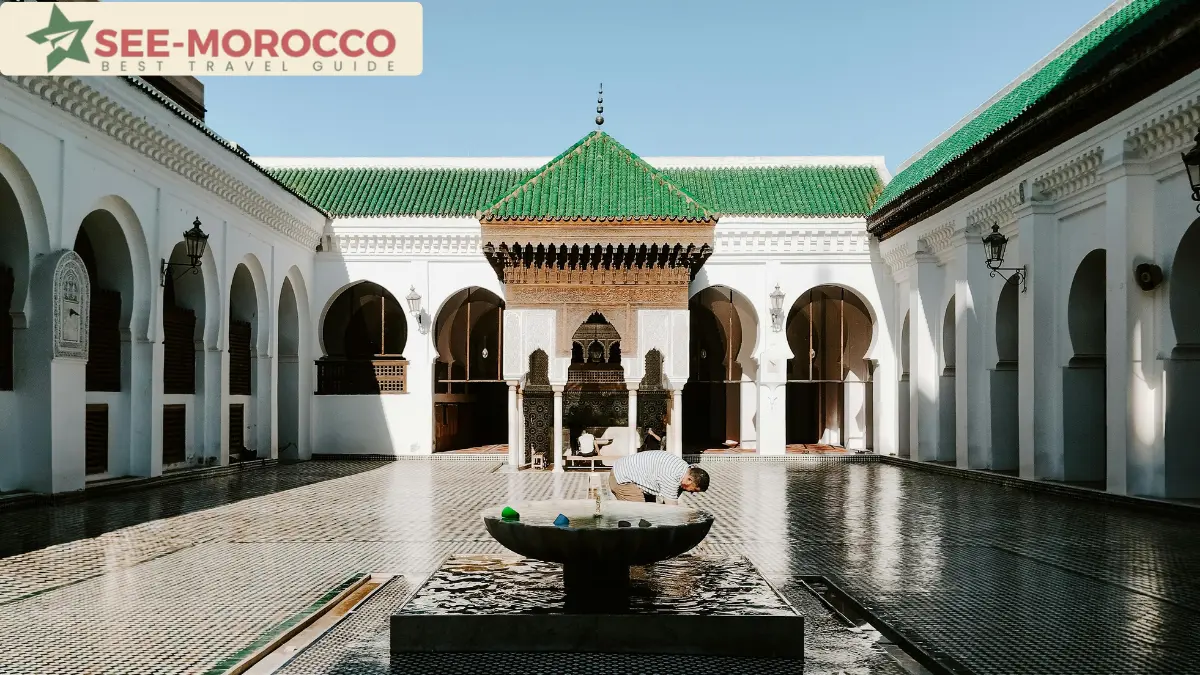
Tucked inside the medina, easy to walk past without realizing what you’re looking at, is the University of Al Quaraouiyine. Founded in 859 CE by Fatima al-Fihri, it’s recognized by UNESCO and Guinness World Records as the oldest continuously operating educational institution in the world — older than any university in Europe.
Rachid, walking with me that day, pointed out something I hadn’t known — that this wasn’t just the oldest university, but according to him, also home to one of the oldest public royal libraries in the world, tucked within the same complex.
Non-Muslim visitors can’t enter the mosque and university complex itself, but you can glimpse the courtyard and intricate zellige tilework through the main doorway, and it’s worth the short detour just to stand in front of a place with thirteen centuries of continuous academic history behind it. For a city so associated with leather and dye, it’s easy to forget that Fez was — and in many ways still is — one of the most important centers of Islamic scholarship in the world.
Chouara Tannery: Beautiful From Above, Brutal on the Nose
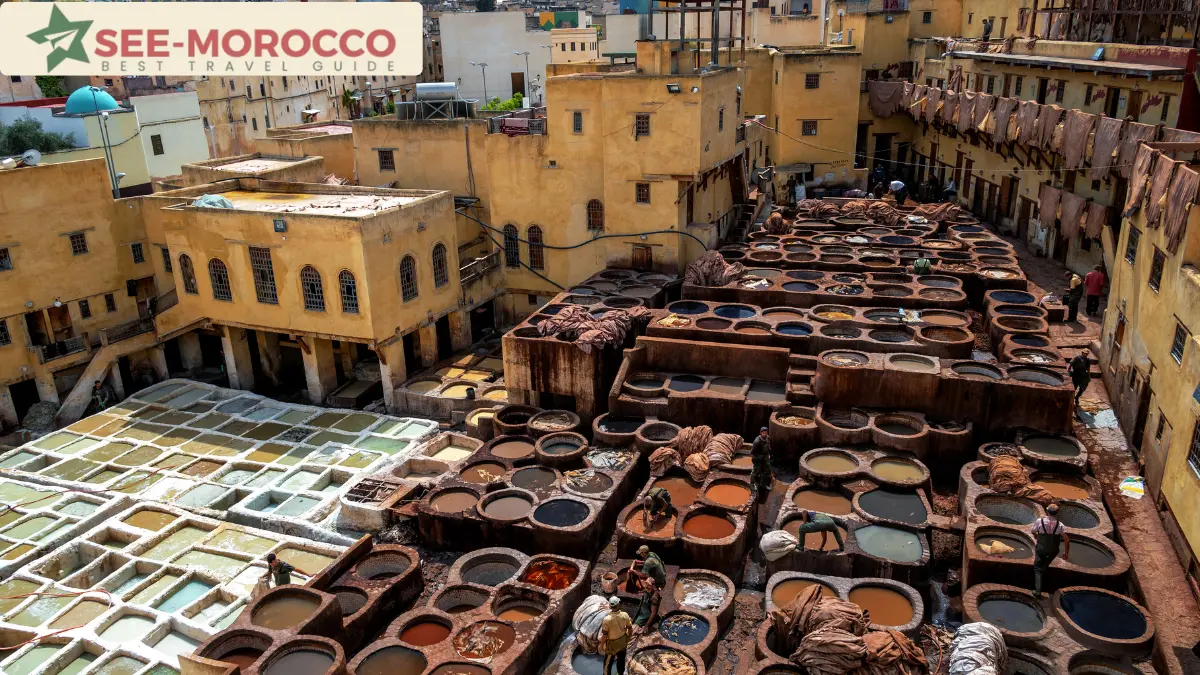
No honest account of Fez can skip the Chouara Tannery, and I mean honest in both directions — it’s genuinely one of the most striking sights in Morocco, and it genuinely smells rough.
Chouara is the largest of Fez’s three tanneries and dates back to roughly the 11th century. The process hasn’t changed much since then: hides are treated in a sequence of stone vats filled with a mix of things you don’t want to think too hard about while standing over them — cow urine, quicklime, pigeon droppings, and various natural dyes made from poppy, indigo, and saffron. The vats form a honeycomb pattern that, from one of the surrounding leather shop terraces, looks almost like a giant painter’s palette.
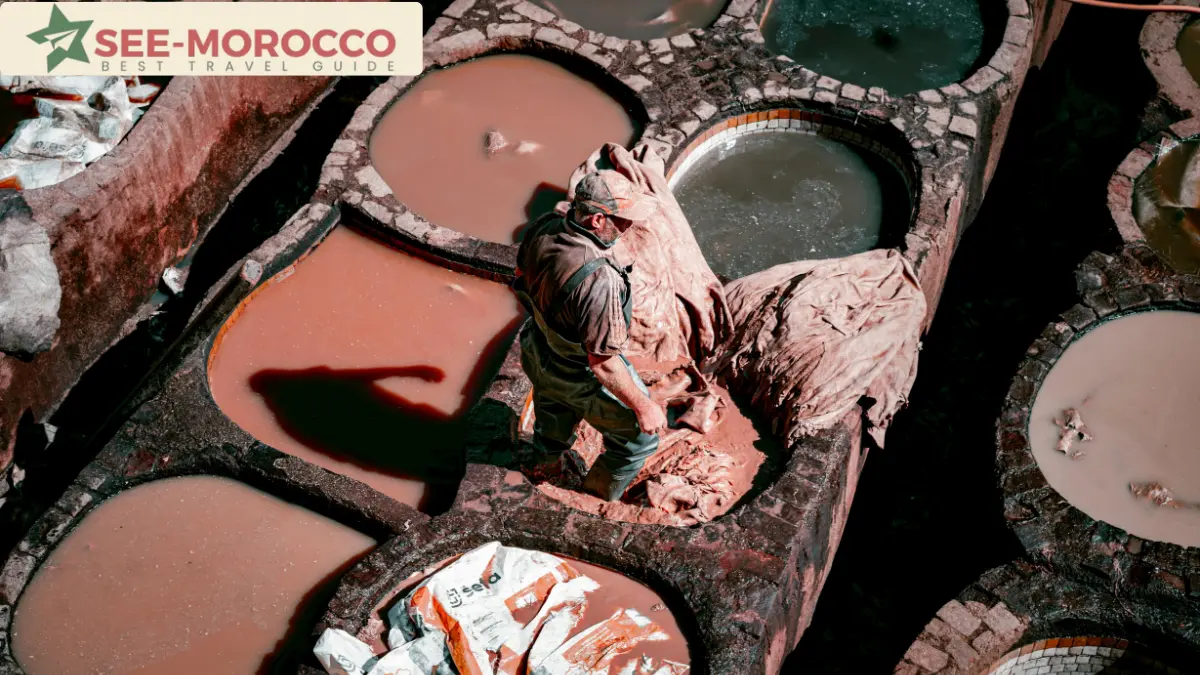
Here’s the part every guidebook mentions and it’s true: shop owners at the entrances hand you a sprig of fresh mint as you climb to the viewing terraces — mine cost a single dirham from a small stall right before the tannery entrance, and I pressed it under my nose the entire time. It genuinely helps. The smell is strong enough that without it, most visitors don’t last more than a couple of minutes on the terrace before needing air.
Watching the leather workers standing knee-deep in the dye vats, treading hides by hand, is humbling. It’s hard, unglamorous work, done the same way it’s been done for roughly a thousand years, to produce the bags, jackets, and babouches sold just a few meters away. If you’re planning to buy leather goods in Fez, this is the place — but go in expecting to negotiate, and expect the tannery-adjacent shops to charge a premium for the terrace access “free mint” experience. I ended up buying a pair of leather babouches from a shop a few alleys away from the main tannery terraces, after negotiating down to 50 dirhams — noticeably less than what the terrace-adjacent shops were asking for the same quality.
Beyond leather, the medina’s textile shops are worth browsing too — I picked up a hand-stitched jellaba for 150 dirhams after some back-and-forth with the shop owner, which felt like a fair price once I’d compared a few stalls.
The Mellah: Fez’s Historic Jewish Quarter
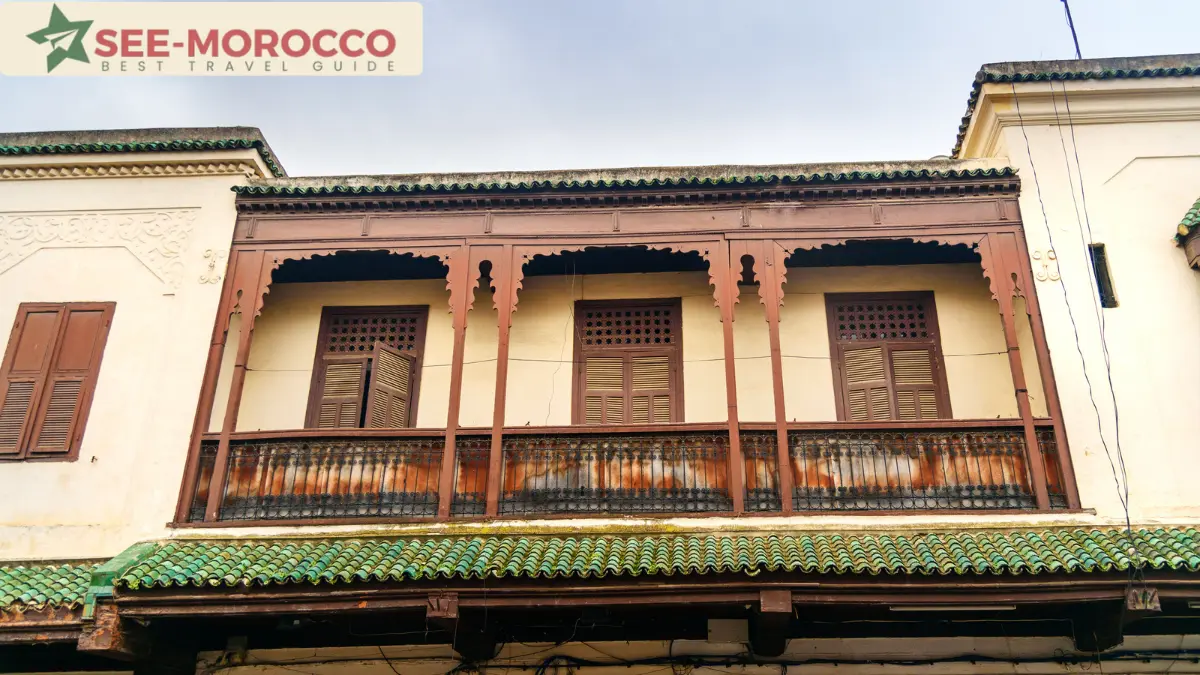
A short walk from the medina brings you to the Mellah, Fez’s historic Jewish quarter, established in the 15th century. It was actually one of the first Mellahs built in Morocco, and it has a completely different architectural character from the rest of the city — the buildings here have wooden balconies and larger street-facing windows, a clear break from the more closed, inward-facing architecture typical of the medina.
Walking through, you’ll notice old synagogues, some still standing and partially restored, along with what used to be a thriving Jewish silver and jewelry trade. The community here is much smaller today than it once was, but the quarter’s layout and buildings still tell that history clearly if you take the time to look. It’s a quieter, less crowded part of the city, which made for a good contrast after the intensity of the tanneries.
Jnan Sbil Gardens: Fez’s Quiet Exhale
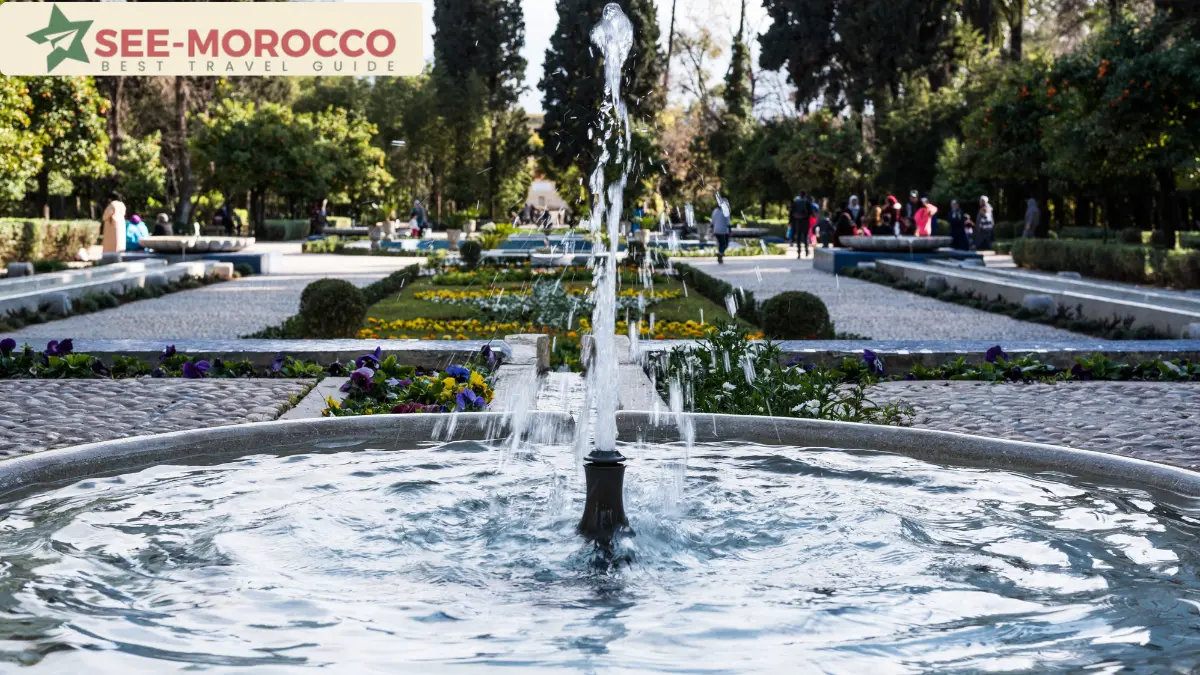
After the sensory intensity of the medina and the tannery, Jnan Sbil Gardens felt like stepping into a different city entirely. These gardens, tucked between the old and new parts of Fez, date back to the 18th century and were beautifully restored a few years ago.
We visited in spring, which is genuinely the right time to see this place — the diversity of flowers in bloom was the thing that struck me most. Rows of different flower beds, tall shading trees, quiet walking paths, and a central pond with a small boat dock all combined into something calm and unhurried, a sharp contrast to the medina’s constant motion. Local families were there too, relaxing on benches, kids running along the paths — it’s clearly a place Fassis (people from Fez) use for themselves, not just a stop for visitors.
If you only have limited time in Fez, I’d still recommend carving out even 30–45 minutes here. It’s free to enter, shaded, and honestly a good place to sit down and process everything you’ve just seen in the medina.
Eating in Fez Morocco
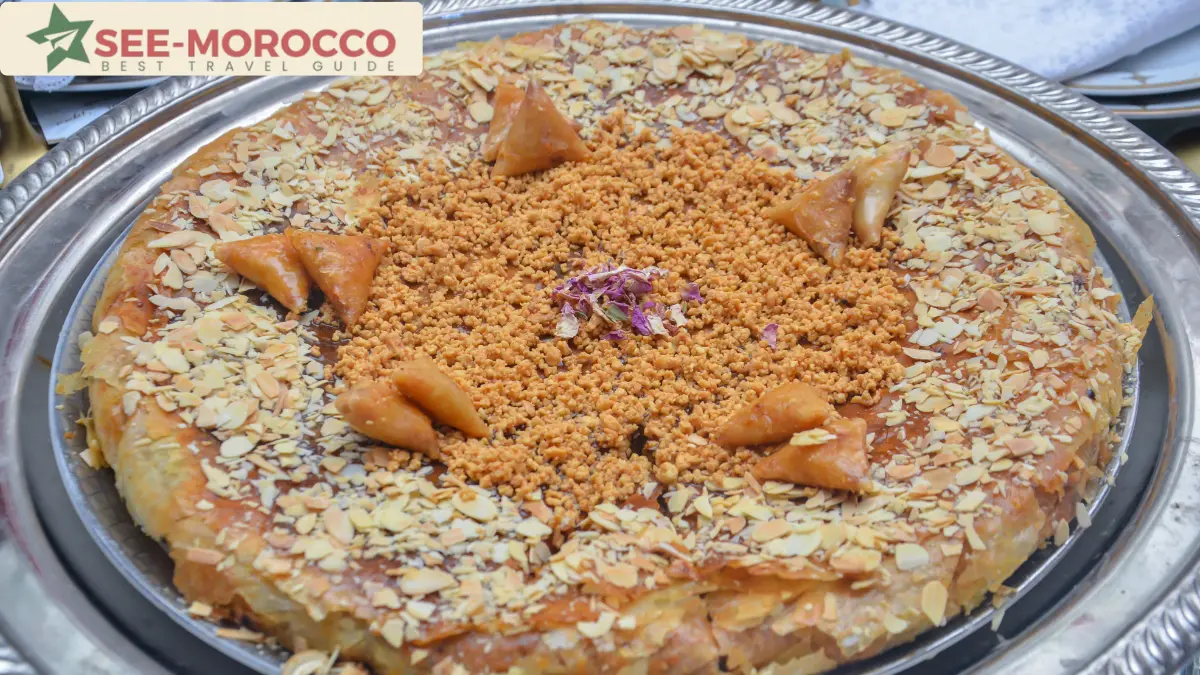
Fassi cuisine has a reputation among Moroccans themselves as one of the country’s most refined culinary traditions, and after two days there I understood why. A few things worth trying:
Pastilla is arguably Fez’s signature dish — a sweet-and-savory pie traditionally made with pigeon (though chicken versions are common now), wrapped in thin warqa pastry, dusted with cinnamon and powdered sugar. It sounds like an odd combination until you taste it.
Harira here tends to be richer than versions found elsewhere in Morocco, often thickened further and served with dates. If you want to try making it yourself at home, I’ve also written about how to cook couscous the traditional way, which shares some of the same family cooking traditions.
Street food in the medina is everywhere, but it’s worth being a little selective — stick to stalls with high turnover and visible fresh ingredients, the same rule that applies anywhere in Morocco. A cup of fresh orange juice from one of the medina’s juice carts costs next to nothing and is a good way to cool down between alleys.
Practical Tips for Visiting Fez Morocco
How long to stay: Two days is a reasonable minimum to see the medina, the tannery, and the gardens without rushing. If you want to also see the Royal Palace gates, the Mellah properly, Al Quaraouiyine, and take a day trip to nearby attractions, three days is more comfortable.
Getting a guide: Given how easy it is to lose your bearings, a local guide for at least your first half-day is genuinely worth it — not just for directions, but for context you’d otherwise miss walking past workshops and buildings blind. Official guides can be arranged through your riad or through the tourism office near the medina.
Where to stay: Staying inside the medina itself, in a traditional riad, is worth the trade-off of navigating narrow alleys with your luggage. It puts you within walking distance of everything and lets you experience the medina in the early morning and evening, when it’s quieter and, in my opinion, more atmospheric than the midday crowds.
Best season: Spring and autumn are ideal. Summer in Fez gets uncomfortably hot in the enclosed medina alleys, and the tannery smell only intensifies with heat. Winter is mild but some mornings can be surprisingly cold before the sun clears the tall medina walls.
Budget expectations: Leather goods at tannery-adjacent shops run higher than elsewhere in the medina — always negotiate, and don’t be afraid to walk away and compare prices at two or three shops before buying. Small items like mint sell for around 1 dirham, while a good pair of negotiated babouches can run around 50 dirhams and a hand-stitched jellaba around 150 dirhams away from the tourist-heavy terraces.
ther and handicrafts caught your interest here, it’s worth reading more about Moroccan handicrafts more broadly, since Fez is where a lot of that tradition is at its strongest.
Frequently Asked Questions About Visiting Fez
How many days do you need in Fez Morocco? Two days is the minimum to see the medina, Chouara Tannery, and Jnan Sbil Gardens without rushing. Three days gives you room for the Mellah, Al Quaraouiyine, and a proper look at everything without feeling rushed.
Is Fez worth visiting if I’ve already seen Marrakech? Yes — Fez and Marrakech are genuinely different experiences. Marrakech is more polished and tourist-oriented, while Fez el-Bali feels older, rawer, and less designed around visitors. Most travelers who do both say Fez left a stronger impression.
Do I need a guide in Fez Morocco? Not strictly, but it’s genuinely useful. The medina has over 9,000 alleyways, and getting lost is common even for people who’ve visited before. A guide for your first half-day saves time and adds context you’d otherwise miss.
What is the smell at the tannery, and how do people deal with it? The tanning process uses natural materials including quicklime and pigeon droppings, which produce a strong smell. Shop owners hand out fresh mint sprigs at the entrance — pressing it under your nose genuinely helps.
Can non-Muslims enter Al Quaraouiyine mosque and university? No, non-Muslim visitors cannot enter the mosque and university complex itself, but you can view the courtyard and zellige tilework through the main doorway.
Is the Royal Palace in Fez open to the public? No. Like the Royal Palace in Rabat, the palace grounds in Fez are not open to public visitors. You can see the exterior gates, but not enter.
What’s the best time of year to visit Fez? Spring and autumn are ideal, with comfortable temperatures for walking the medina. Summer gets very hot in the enclosed alleys, and the tannery smell intensifies with heat.
How do I get to Fez from other Moroccan cities? Fez has its own airport (Fès–Saïss) and is well connected by train to Casablanca, Rabat, Meknes, and Marrakech, making it easy to include in a broader Morocco itinerary.
Final Thoughts
Fez Morocco asks more of you than some other Moroccan cities. It’s not a place for a rushed half-day stop — it rewards people willing to slow down, get lost on purpose, and let the medina do what it’s done for over a thousand years: absorb you completely. Two days there left me with far more memories than the itinerary suggested it would, and honestly, I understood exactly why every traveler I met kept saying the same thing.