Ouarzazate Morocco gets misunderstood more than any city in the south — and most visitors leave having seen only the surface.
They can tell you Russell Crowe stood on that hill for Gladiator. They’ve seen the Game of Thrones episodes filmed at Ait Benhaddou. They know Atlas Film Studios is the largest in Africa. What they don’t know — what nobody tells them — is what makes Ouarzazate genuinely extraordinary beyond its cinematic credentials.
I’m going to tell you both. The films matter here, and they’re worth understanding. But Ouarzazate without the films would still be one of the most compelling places in Morocco. That’s the story most guides skip.
Where Ouarzazate Actually Is (And Why That Matters)
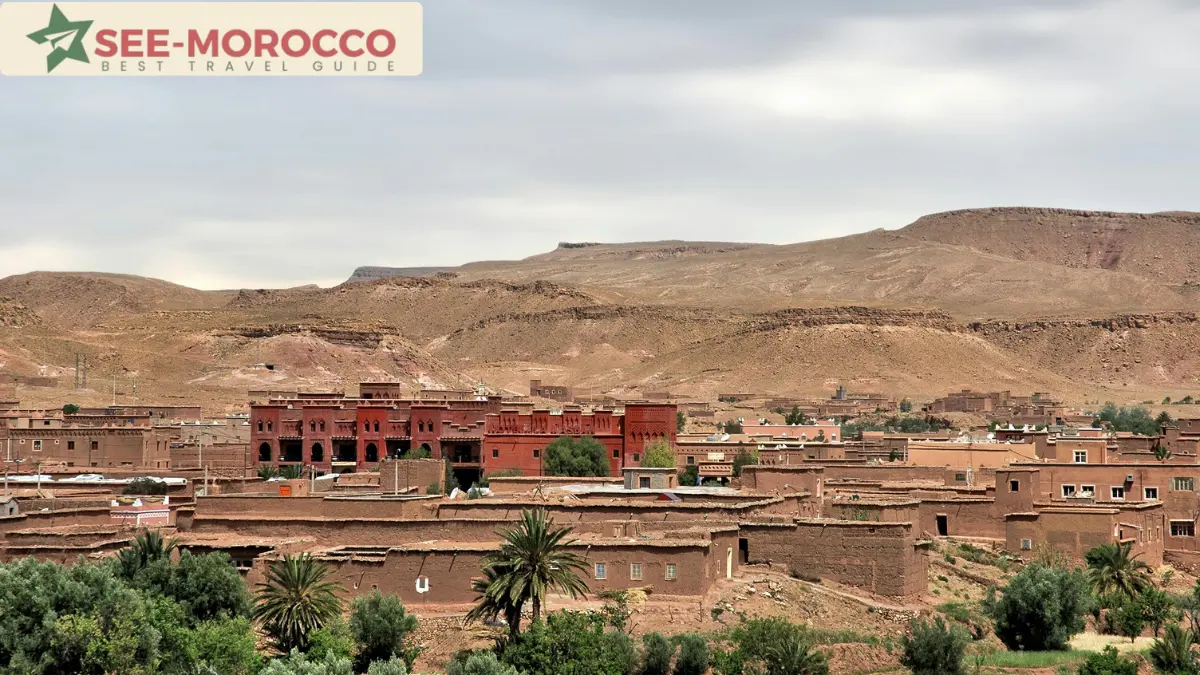
Ouarzazate sits at 1,160 meters above sea level in the pre-Saharan south of Morocco, at the junction of three valleys: the Draa, the Dadès, and the Sous. It’s 200km southeast of Marrakech over the Tizi n’Tichka pass — the highest paved road in Morocco, reaching 2,260 meters. The drive is spectacular and worth doing in daylight.
This geography explains everything about Ouarzazate. It’s not a Sahara city — the real sand dunes are still 3-4 hours east at Erg Chebbi. What Ouarzazate is, is the last proper city before the landscape becomes something else entirely. South and east of Ouarzazate Morocco, the palm oases start, the kasbahs multiply, and Morocco becomes a different country.
The name comes from the Tamazight language — “Ouarzazate” roughly translates as “without noise” or “without confusion.” Standing at the edge of the Taourirt Kasbah at dawn, looking over the Draa Valley toward the Anti-Atlas, I understand why the Berbers named it that.
Ait Benhaddou — Honest Assessment of Morocco’s Most Photographed Kasbah
Every list puts Ait Benhaddou first. Let me give you an honest picture.
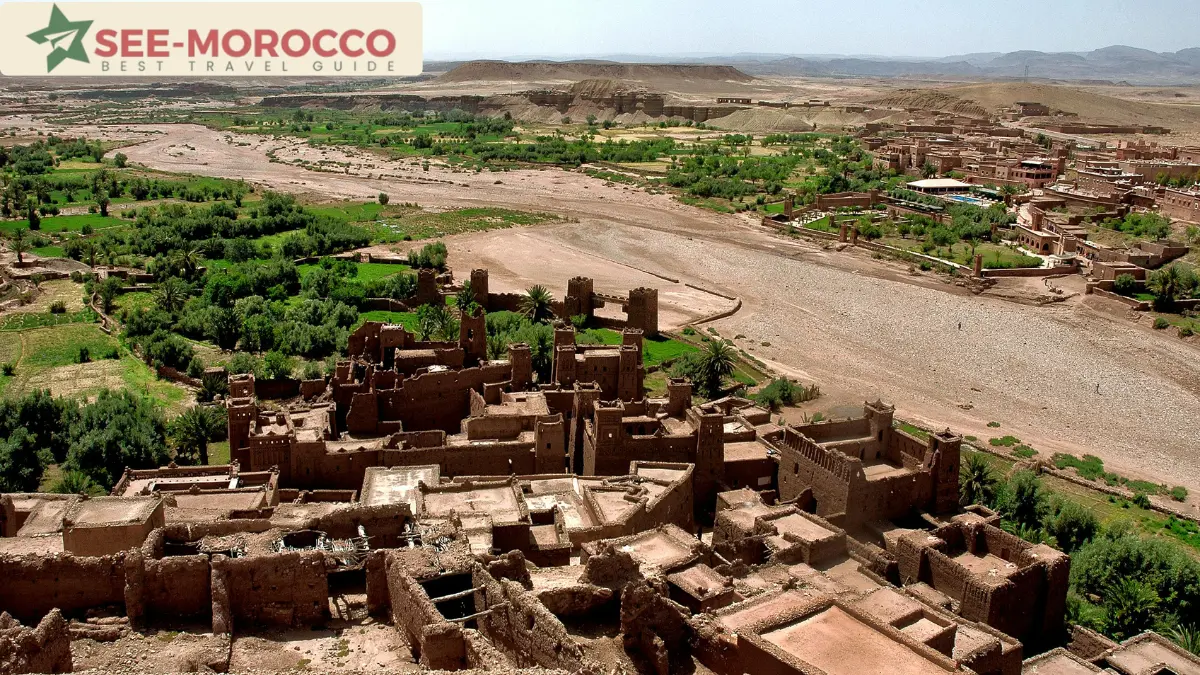
Ait Benhaddou is 30km northwest of Ouarzazate Morocco on the N9 road toward Marrakech. It’s a UNESCO World Heritage ksar — a fortified village of earthen architecture built on a hillside above a seasonal riverbed. The Oued Mellah runs below it. In summer, the river is ankle-deep and you cross on stepping stones. In winter after rain, you take the wooden boat (10 MAD, optional, worth it for the theatrical entrance).
What the photos don’t show: the ksar is still partially inhabited. A handful of families live inside, which creates an odd coexistence between tourist flow and genuine daily life. You’ll see satellite dishes on 17th-century mud-brick walls. A shop selling Coca-Cola in a doorway that appears in Gladiator. This isn’t a complaint — it’s real, and it’s interesting.
What films were actually shot here: Lawrence of Arabia (1962), Jesus of Nazareth (1977), The Last Temptation of Christ (1988), The Mummy (1999), Gladiator (2000), Alexander (2004), Prince of Persia (2010), Game of Thrones Season 3 (Yunkai scenes).
What to actually do:
- Cross the river and walk up through the ksar — the lower sections are crowded, the upper sections near the granary are almost empty
- Climb to the top for the view down the Draa Valley toward the Anti-Atlas — this view is why directors keep coming back
- Budget 2-3 hours, not the 45 minutes most day-trippers allow
Practical details:
- Entrance: 30 MAD per person (often collected informally by residents — you may be charged multiple times as you go deeper in; 30 MAD total is the correct amount)
- No official closing time — arrive before 9am or after 4pm to avoid tour groups from Marrakech
- The restaurants facing the ksar from across the river are priced for tourists; cross the river and eat at the village side instead
Atlas Film Studios — Worth Visiting, But Know What You’re Getting
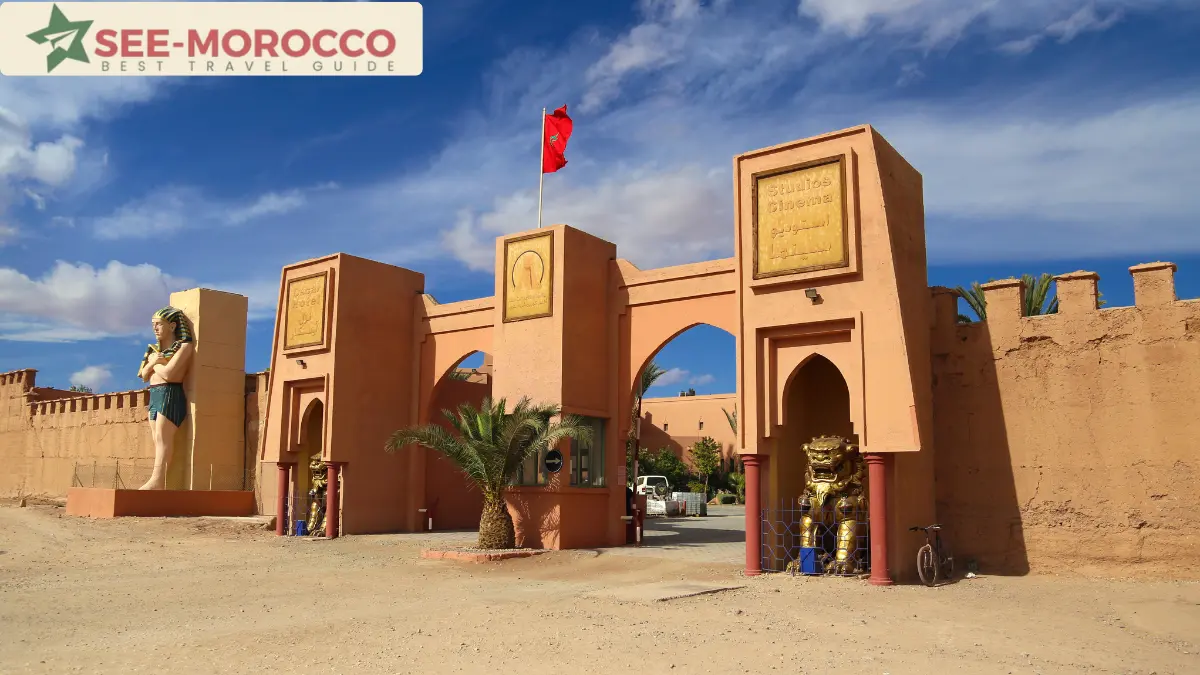
Atlas Film Studios is 6km from Ouarzazate Morocco on the Marrakech road. It’s the largest film production facility in the world by surface area — over 30 hectares of outdoor sets, workshops, and soundstages.
I’ll be honest about what it is: a working studio that opens its gates to tourists between productions. What you see depends entirely on when you visit. I’ve been when the Egyptian market set from a recent production was still standing — genuinely impressive. I’ve also been when most sets were bare or dismantled. You don’t know in advance which you’ll get.
What’s always there: The permanent outdoor sets including a scaled version of ancient Jerusalem, an Egyptian temple complex, an ancient Roman street, and various desert fort structures. The prop and costume warehouse — if your guide knows to take you there — is extraordinary. Hundreds of helmets, shields, armor, and props from productions spanning 60 years.
Entrance: 80 MAD per person, guided tour included (in French or Arabic; English guides available on request) Duration: 1-1.5 hours Best time: Mornings, before Marrakech day-trip coaches arrive around 11am
The honest verdict: If you’re interested in film and production design, go. If you’re expecting a theme park experience with actors in costume, you’ll be underwhelmed. It’s a real working studio, not an attraction designed to impress tourists.
The Taourirt Kasbah — What Most Visitors Miss
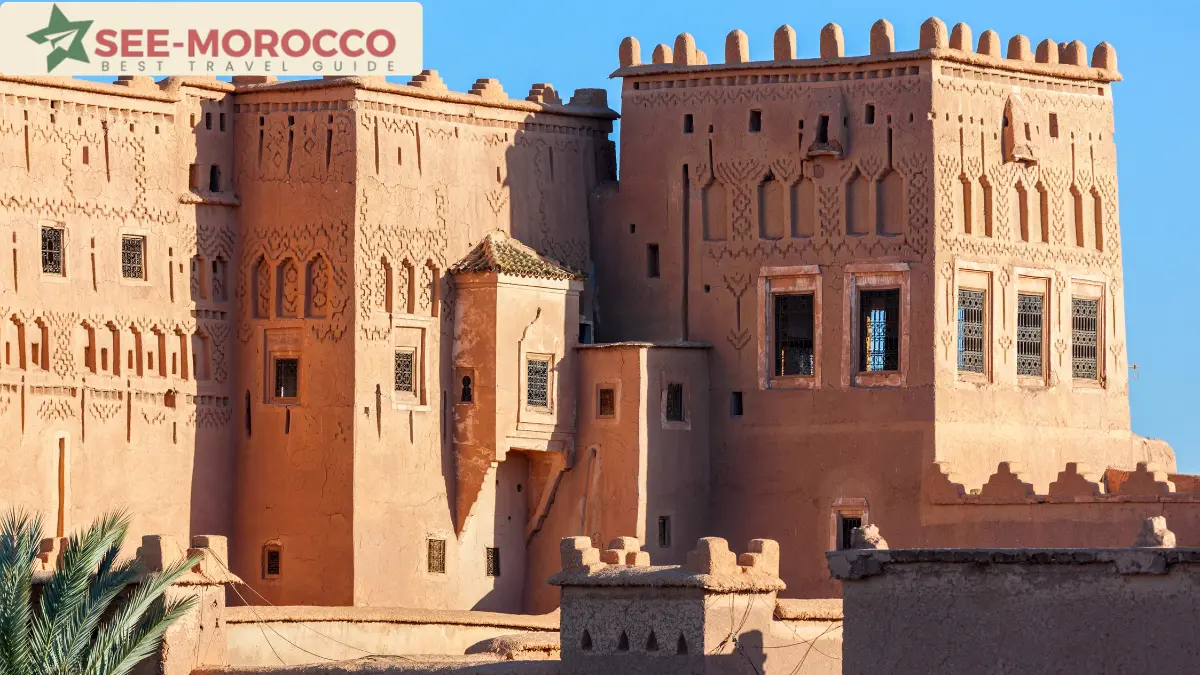
While tourists pile into day trips to Ait Benhaddou, the Taourirt Kasbah sits in central Ouarzazate receiving a fraction of the visitors it deserves.
The Taourirt was the seat of Thami El Glaoui — the Pasha of Marrakech who became one of the most powerful and controversial figures in 20th-century Moroccan history. The kasbah complex grew throughout the 19th and early 20th centuries as the Glaoui dynasty expanded its influence. At its peak, it housed several hundred people — family members, servants, guards, artisans — in an intricate network of rooms, corridors, and courtyard gardens.
El Glaoui collaborated with the French protectorate and was instrumental in the exile of King Mohammed V in 1953. After Moroccan independence in 1956, his legacy was complicated — he died six months after independence, his family’s properties were nationalized, and his name became politically sensitive. The kasbah reflects all of this complexity.
What you actually see: The restored section — perhaps 20% of the original complex — shows off extraordinary zellige tilework, carved cedar ceilings, and painted plasterwork in styles that blend Moroccan, Andalusian, and sub-Saharan influences. The unrestored sections (walk around the exterior) show the earthen architecture in various states of natural decay — erosion, collapse, reconstruction. It’s architecturally as interesting as the restored interior.
Practical details:
- Entrance: 50 MAD
- Open daily, roughly 9am-6pm
- A licensed guide adds real value here — the history of El Glaoui is fascinating and poorly explained by the signs alone
- Budget 1.5-2 hours
The Draa Valley — The Drive Nobody Tells You to Take
Here’s the Ouarzazate recommendation I make to everyone who asks: drive the Draa Valley south.
From Ouarzazate, the N9 road heads southeast along the Draa River for 170km to Zagora. This is one of the most beautiful drives in Morocco and one of the least traveled by visitors who aren’t specifically seeking it.
The road passes through what feels like an unbroken oasis — the Draa is the longest river in Morocco, and for much of this stretch it’s lined with date palms, fig trees, and cultivated plots that stand in impossible green contrast to the surrounding desert rock. Every 20-30km, a new ksar appears on the hillside. Some are inhabited. Many are abandoned.
Specific stops worth making:
- Agdz (60km from Ouarzazate) — a small market town with a Thursday souk that’s genuinely local rather than tourist-oriented. The Caïd’s Palace overlooks the town. Stop for coffee.
- Tamnougalt kasbah — 10km past Agdz, one of the best-preserved kasbahs on the valley route, rarely visited. The caretaker family will show you around for 20-30 MAD.
- Zagora — the endpoint, with a famous sign saying “Tomboctou 52 jours” (52 days to Timbuktu by camel). The town is functional rather than beautiful, but the Jbel Zagora massif behind it and the palm groves of the Draa are worth the drive.
You don’t need to go all the way to Zagora to make the drive worthwhile. Even 60-80km down the valley and back gives you something most Ouarzazate visitors entirely miss.
The Dadès Gorge and Todra Gorge — Ouarzazate as Base Camp
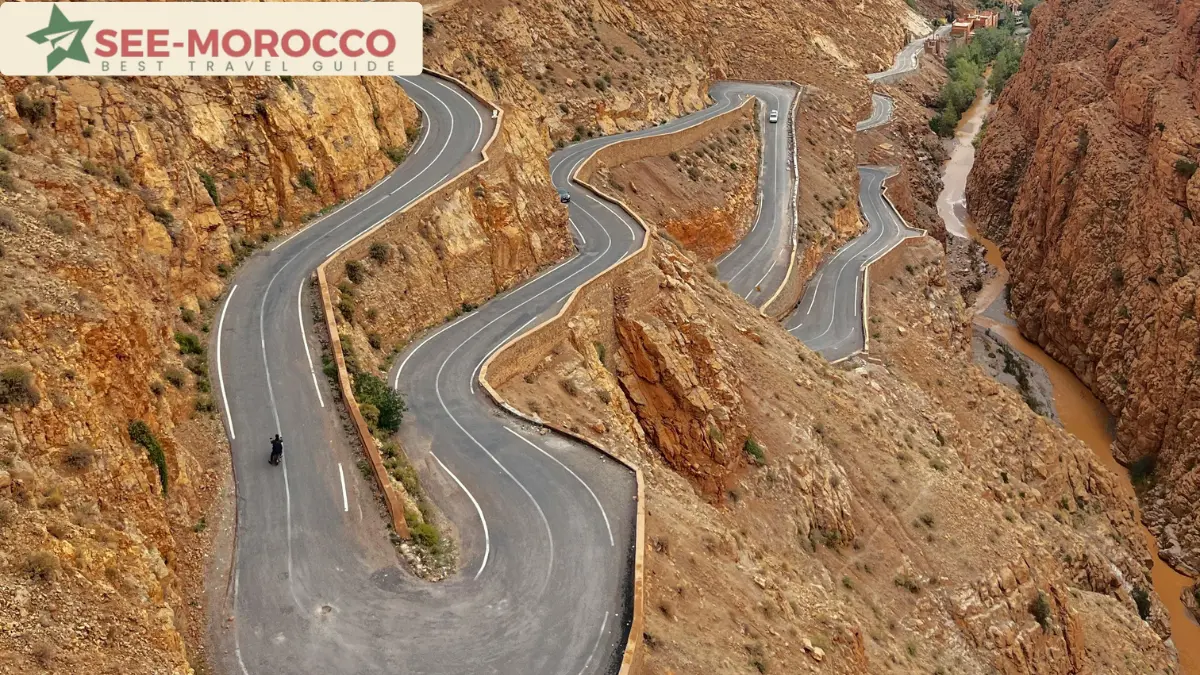
The gorges are why many travelers specifically base themselves in Ouarzazate or the valley towns rather than rushing through.
Dadès Gorge (120km northeast of Ouarzazate via the N10 “Route of the Thousand Kasbahs”): The road into the gorge climbs through increasingly dramatic red rock formations. The famous “monkey fingers” rocks are at the mouth of the gorge. Further in — most visitors only go 20-30km — the canyon narrows and the village of Aït Oudinar is the natural overnight stop. The road continues over a high mountain pass to Msemrir, which requires a 4WD in winter but opens to regular cars from April.
Todra Gorge (180km from Ouarzazate, via the N10 to Tinghir): The Todra narrows to 10 meters wide between 300-meter walls at its most dramatic point. A cold river runs through the bottom year-round. The narrow section takes 15 minutes to walk through — but most people stay for 2 hours because the gorge widens into something equally beautiful further up. The site has been over-developed at the entrance: tourist restaurants, souvenir sellers, camel rides. Walk past all of them. The gorge gets better the further you go.
Combining both: It’s possible to drive from Ouarzazate through the Dadès Gorge, over the pass (road conditions permitting), down to Todra, and return to Ouarzazate in one long day. I wouldn’t recommend it — too much driving, not enough time in either gorge. Better to overnight in the Dadès valley and take the gorges at a pace that lets you actually see them.
Getting to Ouarzazate Morocco — Your Real Options
From Marrakech by road (most common): 3.5-4 hours via the Tizi n’Tichka pass. The pass road is excellent and well-maintained. Do it in daylight — the views are half the point. In winter, the pass occasionally closes due to snow; check conditions before heading out. A grand taxi from Marrakech costs around 70-80 MAD per seat (shared with 5 other passengers), or 400-450 MAD for the whole vehicle.
By plane: Ouarzazate airport (OZZ) receives Royal Air Maroc flights from Casablanca (1 hour). Frequency varies — currently 3-4 flights per week. Fares run 400-800 MAD each way. If your time is limited, flying in and driving the valley roads makes more sense than spending 4 hours each way on the pass.
As part of a 3-day desert tour from Marrakech: This is how most visitors encounter Ouarzazate — briefly, as a lunch stop on the way to the Sahara. This undersells the city significantly. If you’re doing the 3-day tour, consider spending an extra night in Ouarzazate at the beginning or end.
By bus: CTM buses run Marrakech-Ouarzazate twice daily (roughly 5 hours, 110 MAD). Comfortable enough. The bus station is on the main avenue in central Ouarzazate.
Where to Stay in Ouarzazate — The Honest Range
For atmosphere: The guesthouses and small riads in the old part of town near the Taourirt Kasbah give you the best sense of place. Prices run 300-600 MAD per night for a double room with breakfast — modest by Marrakech standards, fair for what you get.
For comfort: The Berbère Palace is Ouarzazate’s established mid-range hotel — pool, reliable service, dated décor but functional. Around 700-1,000 MAD for a double. The Le Zat Hotel is newer and better-designed, similar price range.
For the desert experience: Several guesthouses in the Draa Valley south of Ouarzazate offer genuine earthen architecture with modern bathrooms — the best of both. Dar Kamar in Ait Benhaddou village itself is excellent and puts you inside the ksar rather than facing it from across the river.
Budget reality: Ouarzazate Morocco is significantly cheaper than Marrakech at every level. A good dinner costs 60-100 MAD. Coffee is 10-15 MAD. Taxis within the city charge 20-30 MAD fixed rate.
What to Eat in Ouarzazate
The food in Ouarzazate reflects its position as a crossroads city. The Berber influence is stronger here than in Marrakech — you’ll find dishes you don’t see in the north.
Rfissa — a dish of shredded msemen (flatbread) with chicken, lentils, and fenugreek in a rich broth. It’s intensely savory and filling. Not a restaurant dish — find it at houses and small family guesthouses.
Tafraout — roasted almonds with argan oil and honey, typical of the region. Every market stall sells it. It’s a legitimate local product, not a tourist confection.
Mechoui — slow-roasted whole lamb cooked in an underground clay oven. You’ll sometimes see it being prepared near the souk for weddings and special occasions. If you see it being sold by the portion at the market, buy it immediately.
Where to eat: The restaurants on the main avenue (Avenue Mohammed V) are mostly tourist-priced. Walk two streets back toward the kasbah area and prices normalize. The covered market on the central square has cooked food vendors at lunchtime — bissara (fava bean soup), harira, and grilled meat at 20-40 MAD per portion.
Best Time to Visit Ouarzazate
March, April, and October are the best months — mild temperatures (20-28°C during the day), occasional brief rains that clear the air and briefly green the valley, and manageable tourist numbers.
November through February: The days are pleasant (15-22°C), but nights get cold — genuinely cold, 2-5°C in the gorges and valley towns. The Tizi n’Tichka pass can close. Bring layers. The winter light is extraordinary for photography.
May and September: Still good, warming up. Flowers finished in May; harvest season starting in September.
June through August: I won’t tell you not to come, but 40-42°C in the afternoon is serious heat. The saving grace is that mornings and evenings are manageable, shade is available, and the gorges stay cool. The film crews know this — shooting happens at dawn and dusk. Take the same approach.
Avoid: Coming to Ouarzazate Morocco as a rushed day trip from Marrakech. The drive takes most of the day. You arrive in time for lunch, rush through Ait Benhaddou, and leave before sunset. You see the surface of a place that deserves two or three days minimum.
Practical Information
Money: ATMs are available on the main avenue and near the bus station. The valley towns have fewer — withdraw cash in Ouarzazate before heading south or east. Most guesthouses and small restaurants are cash-only.
Language: Tamazight is the first language of many locals here, with Darija (Moroccan Arabic) second and French third. English is understood in hotels and tourist-facing businesses; less so in the market and smaller villages.
Phone signal: Good in Ouarzazate city. Patchy in the gorges. Nonexistent in some valley sections. Download offline maps before entering the gorge roads.
Guides: For Ait Benhaddou, the Taourirt Kasbah, and Atlas Film Studios, a licensed local guide adds genuine value — the history is complex and the signs don’t explain it well. Expect to pay 150-250 MAD for a half-day guide. Hire through your guesthouse rather than accepting approaches at the site entrances.
FAQ — Ouarzazate Morocco
Is Ouarzazate worth visiting?
Yes — particularly if your Morocco trip includes the south. Ouarzazate sits at the center of the most dramatic landscape in the country: the pre-Saharan south, the Draa Valley, the Dadès and Todra gorges, and Ait Benhaddou. It’s genuinely different from Marrakech and Fes, and most visitors who spend real time here consider it a highlight.
How many days should I spend in Ouarzazate?
Two days minimum. One day for Ait Benhaddou, Atlas Film Studios, and the Taourirt Kasbah. A second day for the Draa Valley drive or the gorges. Three days lets you do all of the above properly.
Is Ouarzazate just a film location?
The film history is real and interesting, but it’s one layer of a much older city. The Glaoui dynasty history, the Berber architecture, the pre-Saharan geography, and the route position between Morocco’s north and south are all independently worth understanding.
How far is Ouarzazate from Marrakech?
210km by road over the Tizi n’Tichka pass — typically 3.5-4 hours driving. The pass road is paved and good condition except in winter snow.
Can I visit the Sahara from Ouarzazate?
You can reach the Erg Chebbi dunes (Merzouga) in 3-4 hours from Ouarzazate via the N10. Zagora, at the end of the Draa Valley, has smaller dunes and a different, quieter character. Ouarzazate is better understood as the gateway to the pre-Saharan south rather than the Sahara itself.
What’s the difference between Ait Benhaddou and the Taourirt Kasbah?
Ait Benhaddou is 30km outside Ouarzazate — a UNESCO ksar built on a hillside, famous for films, partially inhabited. The Taourirt Kasbah is in central Ouarzazate — the former seat of the Glaoui dynasty, partially restored, with more complex historical significance and far fewer tourists.
Is it safe to drive the gorge roads?
The main roads to Dadès Gorge and Todra Gorge are paved and in good condition for regular vehicles. The high mountain road connecting Dadès and Todra via Msemrir requires 4WD and is sometimes closed in winter. The Draa Valley road to Zagora is paved throughout.
Planning to visit Ouarzazate? Leave a comment below with your itinerary and I’ll tell you if you’re allocating your time well.