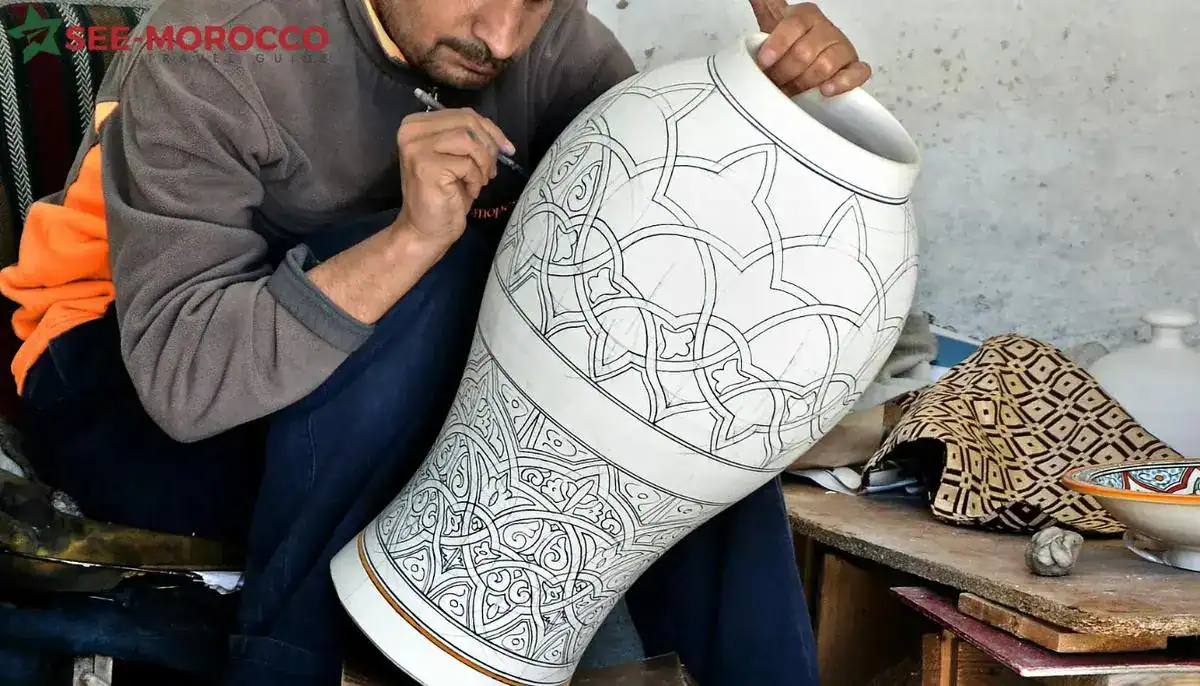
Walk into any souk in Fes or Marrakech and you’ll immediately understand why Moroccan handicrafts have captivated collectors for centuries. It’s not the colours that get you first — though those are extraordinary. It’s the realisation that the person who made what you’re looking at learned from their mother, who learned from her mother, going back generations in an unbroken line of transmission.
I want to talk honestly about Moroccan handicrafts — specifically the three most celebrated categories: rugs, tiles, and pottery. Not the tourist-brochure version. The real history, the real differences between quality and mediocrity, and — most importantly — what to actually look for if you want to buy something genuine.
Part 1: Moroccan Rugs — What You’re Actually Looking At
Of all Moroccan handicrafts, rugs are probably the most internationally recognized — and the most misunderstood.
The Two Traditions You Need to Know
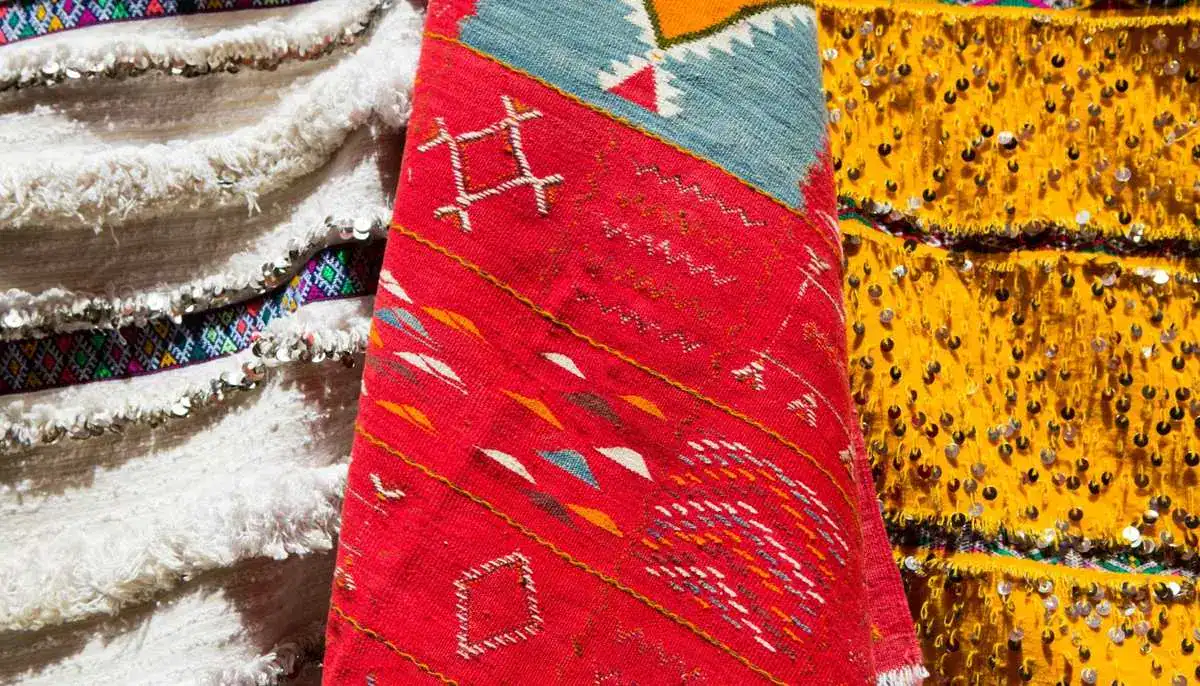
Most people arrive in Morocco having heard of Berber rugs and Beni Ourain rugs, often assuming they’re the same thing. They’re not.
Berber is a broad term referring to the indigenous Amazigh (Berber) people of North Africa. Their weaving traditions go back many centuries and dozens of distinct regional styles. A “Berber rug” can mean almost anything.
Beni Ourain is specific — it refers to rugs made by the Beni Ourain tribe in the Middle Atlas mountains, traditionally in undyed natural wool (ivory and dark brown), with simple geometric patterns that often look strikingly modern. These rugs were “discovered” by Western designers in the mid-20th century, and their minimalist aesthetic influenced everyone from Le Corbusier to contemporary interior designers. Real Beni Ourain rugs are expensive for good reason.
Other distinct traditions worth knowing:
- Azilal rugs — from the High Atlas, typically colorful and abstract, often with symbolic patterns specific to individual weavers
- Boucherouite rugs — made from recycled fabric scraps rather than wool; traditionally practical rather than decorative, now popular for their colorful patchwork look
- Kilim rugs — flat-woven (no pile), thinner, reversible; used traditionally as blankets and coverings as much as floor rugs
How Moroccan Rugs Are Made — The Part That Actually Matters
Understanding the production process changes how you evaluate a rug.
Traditional Moroccan rug weaving happens on a vertical loom. The weaver — most often a woman, in rural areas — works from memory or from patterns passed down within her family. There’s no written pattern, no instructions. The design exists in her hands.
Wool is sheared from sheep in spring, washed, carded, and spun before dyeing. Traditional dyes came from plants and minerals — henna, pomegranate rind, saffron (sparingly — it’s expensive), walnut shells for brown, indigo for blue. Synthetic dyes became widespread in the 20th century. Both can be beautiful; the distinction matters mainly for durability, as natural dyes tend to fade more gracefully while cheap synthetic dyes can look harsh as they age.
The pile (the knotted surface) is created by tying individual knots around the warp threads — typically Turkish (symmetrical) or Persian (asymmetrical) knots. Higher knot density generally means more detail and durability. You can estimate knot density by counting the knots along one inch on the back of the rug.
Identifying Quality — The Honest Test
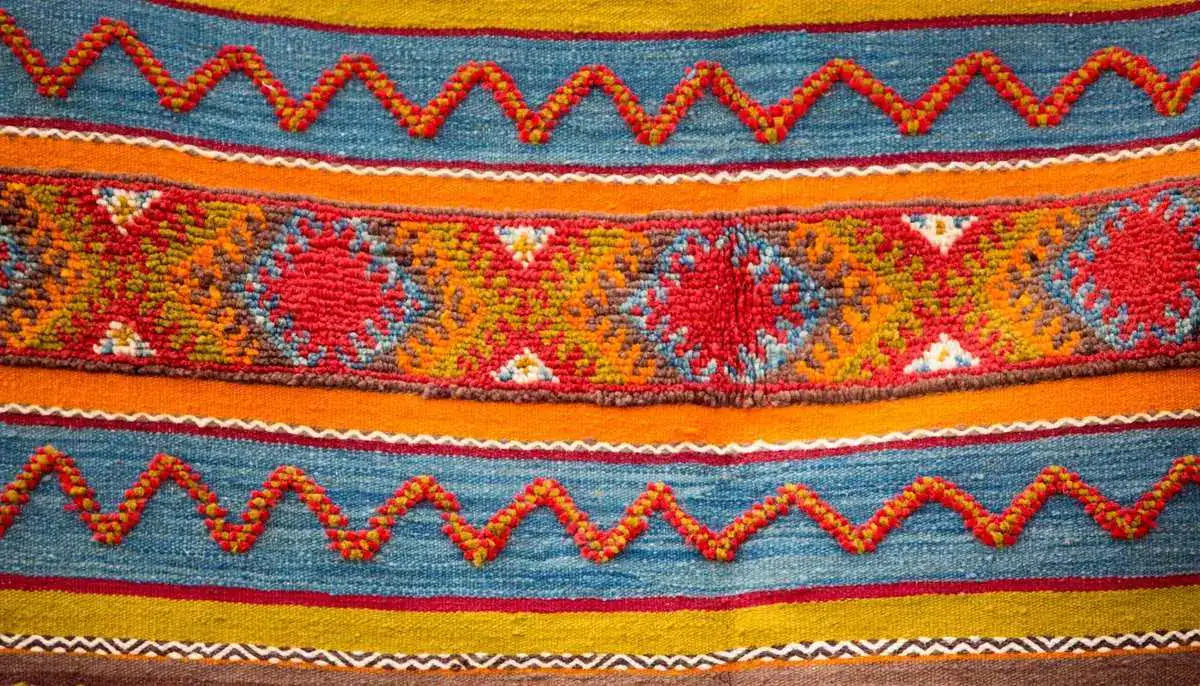
Flip the rug over. The back tells you more than the front.
A quality handmade rug has slight irregularities in the back — knots that vary microscopically in tightness, rows that aren’t perfectly geometrical. This isn’t a flaw; it’s proof that a human made it. Machine-made rugs have perfectly uniform backs. If the back looks like it was printed, it was effectively manufactured rather than woven.
Check the fringe. On a genuine handwoven rug, the fringe is part of the structure — it’s the continuation of the warp threads that the rug is built on. Sewn-on fringe (which you can feel by running your finger along the base of it) is a sign of factory production.
The smell test: genuine wool has a distinct animal smell when new, particularly when it gets wet. Synthetic fibers don’t have this. It’s not a perfect test, but it’s useful.
The burn test: if a seller will allow it (and they should, if they’re confident in their product), pull a single thread from an inconspicuous corner and burn it. Real wool chars and smells like burnt hair, then turns to ash. Synthetic fibers melt and smell like burning plastic.
Where and How to Buy
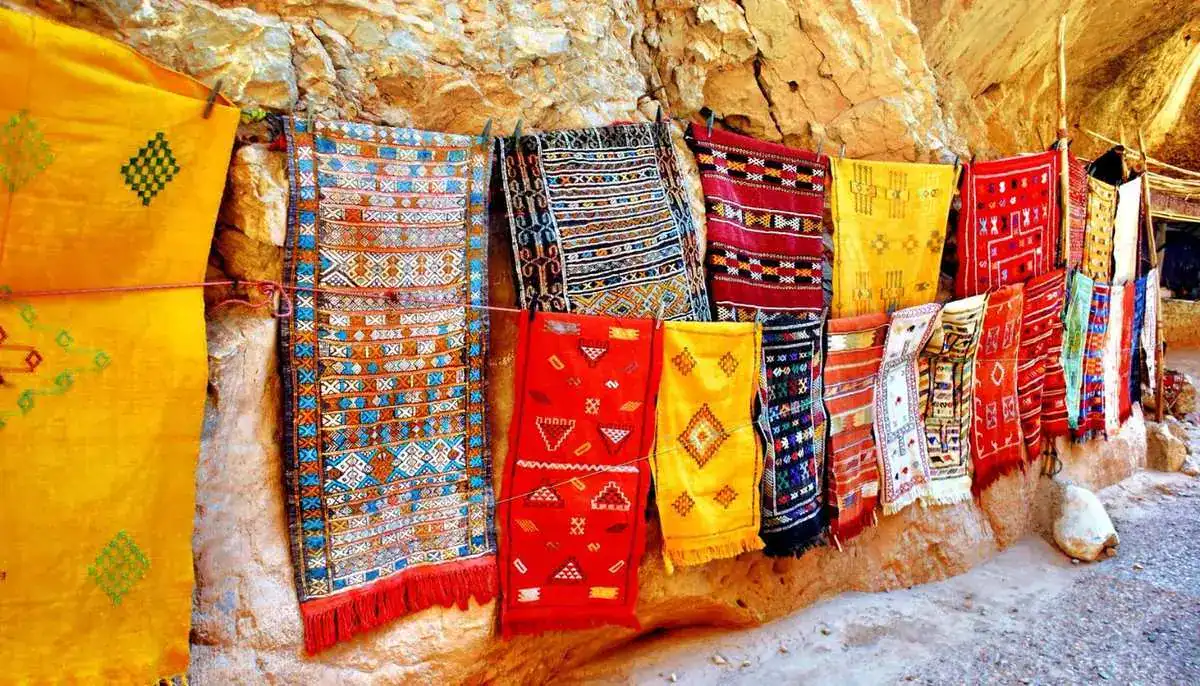
In Morocco’s souks, the rug-buying process is a social ritual with its own etiquette. Tea will be produced. Rugs will be unfurled theatrically. Time is not wasted; this is expected to take a while.
Prices are not fixed. The initial price quoted in tourist areas of Marrakech is typically two to four times what the seller expects to receive. Negotiating is expected and not rude. A good rule: never accept the first price, never make an insulting counter-offer, and know your walk-away number before you start.
In Fes’s medina, rug co-operatives exist where prices are more fixed and quality is more consistent — useful if you find negotiation uncomfortable. The Artisan Centre (Centre Artisanal) in Marrakech also sells at fixed government-suggested prices, which serves as a useful price reference even if you plan to buy in the souk.
Antique Moroccan rugs (genuinely old ones, not the “vintage-style” ones produced for the Western market) require expertise to evaluate. If you’re buying something described as antique, ask for provenance documentation. Absent that, approach with healthy scepticism.
Part 2: Moroccan Tiles — Zellige and Everything After
If rugs are the most recognized of Moroccan handicrafts, zellige tiles are the most architecturally distinctive
What Zellige Actually Is
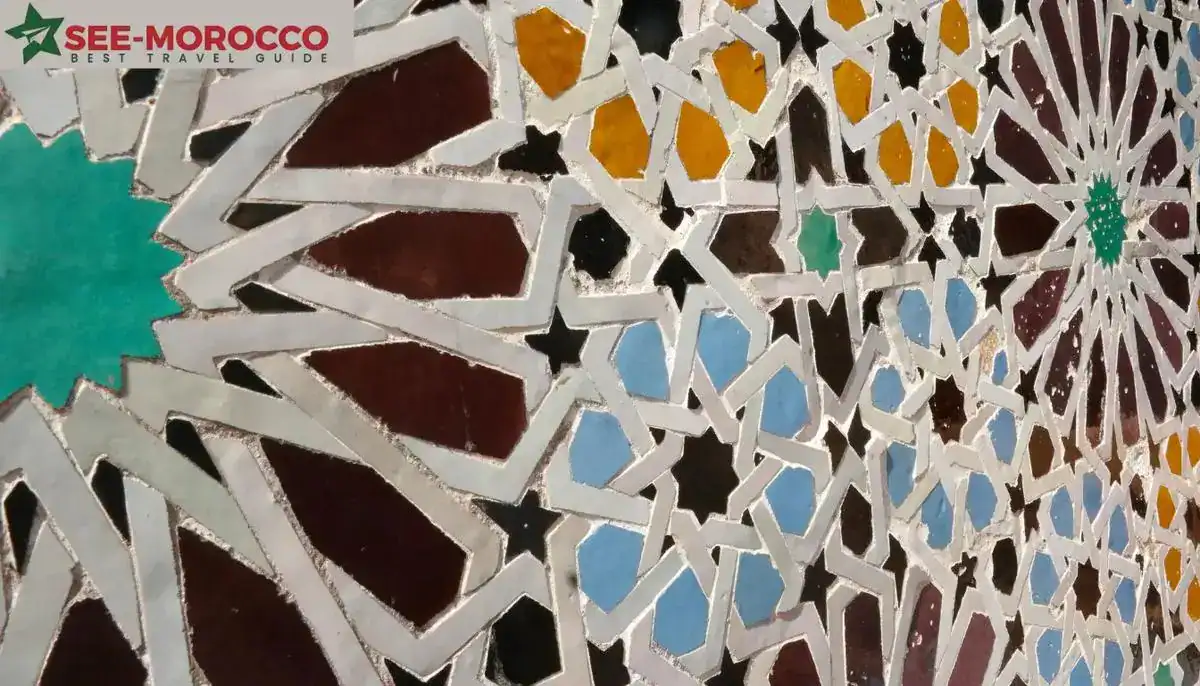
The word “Moroccan tile” has become so diluted in the interior design industry that it now means almost anything with a geometric pattern. Real zellige is something specific and extraordinary.
Zellige (pronounced zell-eeej) is a form of Islamic geometric art translated into ceramic tiles. It’s one of the defining visual languages of Moroccan architecture — covering the floors and wainscoting of mosques, riads, palaces, and madrasas in patterns of staggering mathematical complexity.
The production process has barely changed in centuries. A craftsman (known as a mallem) starts with a fired clay tile and hand-cuts it into specific geometric shapes using a pointed hammer and chisel. These individual pieces — in dozens of possible shapes — are then assembled face-down on a flat surface according to a geometric pattern held entirely in the craftsman’s memory, mortared together, and the whole panel is then flipped over to reveal the completed design.
There’s no digital template. No computer-generated pattern. The geometric knowledge lives in the mallem’s hands and mind. It takes years of apprenticeship to become competent and decades to master.
Fes is the centre of zellige production in Morocco. The potters’ district (Ain Nokbi) has functioned continuously for centuries. Watching a mallem work — the speed and precision of those hammer strikes, the seemingly impossible geometry being assembled without reference to any guide — is genuinely one of the most impressive craft demonstrations I’ve seen anywhere.
Zellige Colours and Their Meaning
Traditional zellige colours weren’t arbitrary. Each had significance within the Islamic artistic tradition:
Blue — the dominant colour in many zellige panels, particularly in religious buildings. Fes blue (a specific cobalt blue derived from cobalt ore) is distinct and slightly different from the blues you see in contemporary reproductions.
Green — associated with Islam and with nature; frequently used in minarets and mosque interiors.
White — purity, and also practically useful as a background colour that makes other colours sing.
Black — used primarily as a separator between other colours, defining the geometric lines.
Terracotta and ochre — earth tones that appear more in domestic architecture than religious buildings.
Contemporary zellige production has expanded this palette significantly, with designers commissioning custom colours for modern interiors. The craftsmanship requirements remain the same regardless of colour.
The Difference Between Zellige and Moroccan-Style Tiles
This distinction matters if you’re buying.
Genuine zellige is hand-cut, slightly irregular, with surfaces that vary microscopically in angle and level. When light hits a zellige wall, it creates a slight shimmer because no two adjacent tiles are perfectly parallel. This is considered a feature, not a defect. Each tile is unique.
Moroccan-style ceramic tiles are industrially produced tiles with printed or stamped Moroccan-inspired patterns. They look clean and consistent. They’re cheaper and more uniform. They’re also not zellige.
Cement tiles (also called encaustic tiles) are another category — made with pigmented cement rather than fired clay, they have a matte finish and different durability characteristics than zellige. Both can be beautiful; they’re different products.
If you’re buying tiles described as zellige, look at them closely. Perfect uniformity is the red flag.
Using Moroccan Tiles at Home
The most common applications:
Backsplashes — zellige or Moroccan cement tiles as a kitchen backsplash is the most accessible way to use this material. A small amount of tile creates significant visual impact.
Bathroom surfaces — zellige is naturally water-resistant (the fired clay glaze) and has been used in hammams (bathhouses) for centuries. The slight variations in tile level can create a slipping risk on floors; seek advice on appropriate sealing and grouting for wet floor applications.
Accent walls — a single wall of zellige in a dining room or entryway, floor to ceiling, is a commitment but a spectacular one.
Furniture surfaces — tiled side tables and mirror frames with zellige surrounds are a more accessible entry point than architectural applications.
The honest maintenance note: zellige requires periodic sealing to prevent staining and, in kitchen applications, needs to be cleaned promptly to prevent grout discolouration. It’s beautiful and it requires care. That’s the honest trade-off.
Part 3: Moroccan Pottery — Clay, Fire, and Centuries of Practice
Pottery completes the holy trinity of Moroccan handicrafts — though regional variation here is even more pronounced than in rugs or tiles.
The Cities of Moroccan Ceramic Art
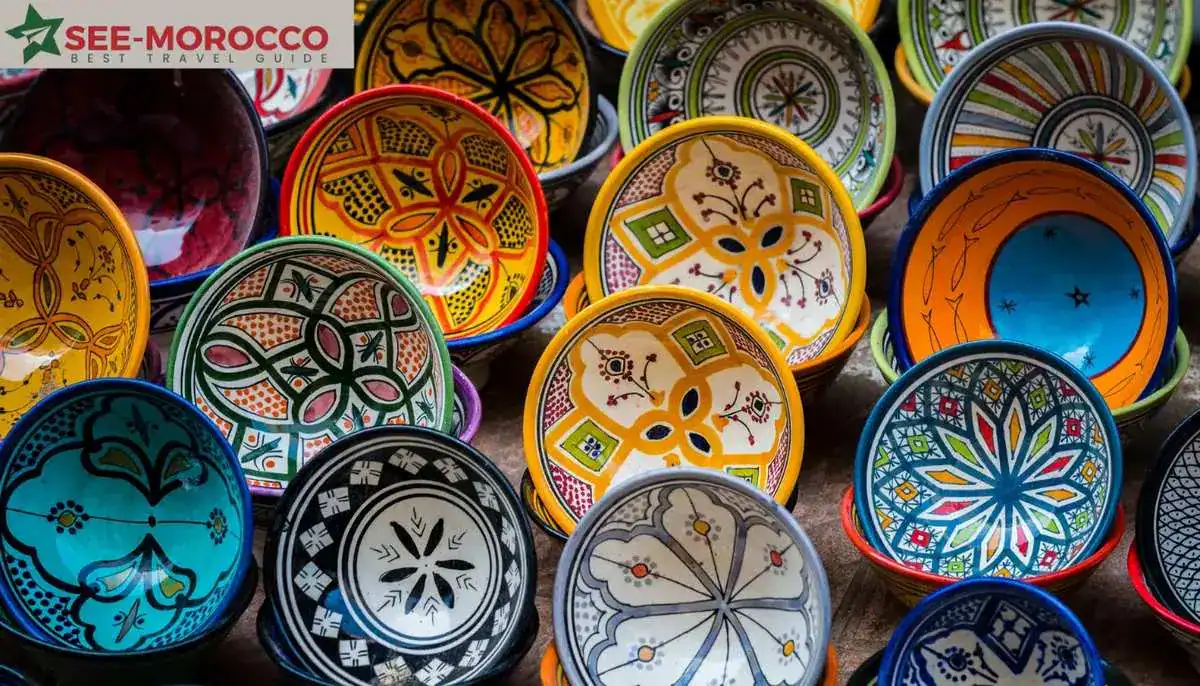
Morocco’s pottery traditions are regional — different cities have developed distinct styles, techniques, and aesthetics over centuries.
Fes produces what most people picture when they think of Moroccan pottery: blue and white faience (tin-glazed earthenware) with detailed geometric and floral patterns. The signature “Fes blue” — the same cobalt blue used in zellige — appears on pottery plates, bowls, and decorative pieces. These are technically sophisticated and relatively expensive when genuine.
Safi is Morocco’s largest pottery centre — a coastal city south of Marrakech that has produced ceramics for export for centuries. Safi pottery tends to be bolder in colour and more accessible in price than Fes ware. The distinctive green glaze characteristic of Safi pottery comes from copper oxide.
Marrakech produces pottery with a more decorative, tourist-oriented character — though excellent craftsmen work here too. The pottery quarter near the tanneries is worth visiting to see production in progress.
Ouarzazate and the south produce simpler, earthier pottery using local clay with less decoration. These pieces have their own honest beauty — practical forms without the elaborate surface decoration of northern city pottery.
Zellige Tiles vs. Pottery: The Tadelakt Connection
Tadelakt deserves separate mention because it’s frequently misunderstood.
Tadelakt is not pottery — it’s a plaster technique using lime (calcium hydroxide) that, when burnished and polished with a specific stone (traditionally a river stone), becomes waterproof and develops a beautiful, almost skin-like surface. It’s been used in Moroccan hammams for centuries.
The technique involves applying multiple coats of the lime plaster, then burnishing each layer with the stone while it’s still wet. The burnishing compresses the surface, closing the pores and creating the waterproof characteristic. Black soap (savon beldi) is then applied to further seal the surface.
Good tadelakt requires significant skill. Bad tadelakt — and there’s a lot of it being applied by untrained hands in the current design-trend market — cracks, doesn’t seal properly, and fails in wet conditions. If you’re commissioning tadelakt for a bathroom, ask to see examples of the craftsman’s previous work.
What Makes Moroccan Pottery Worth Buying
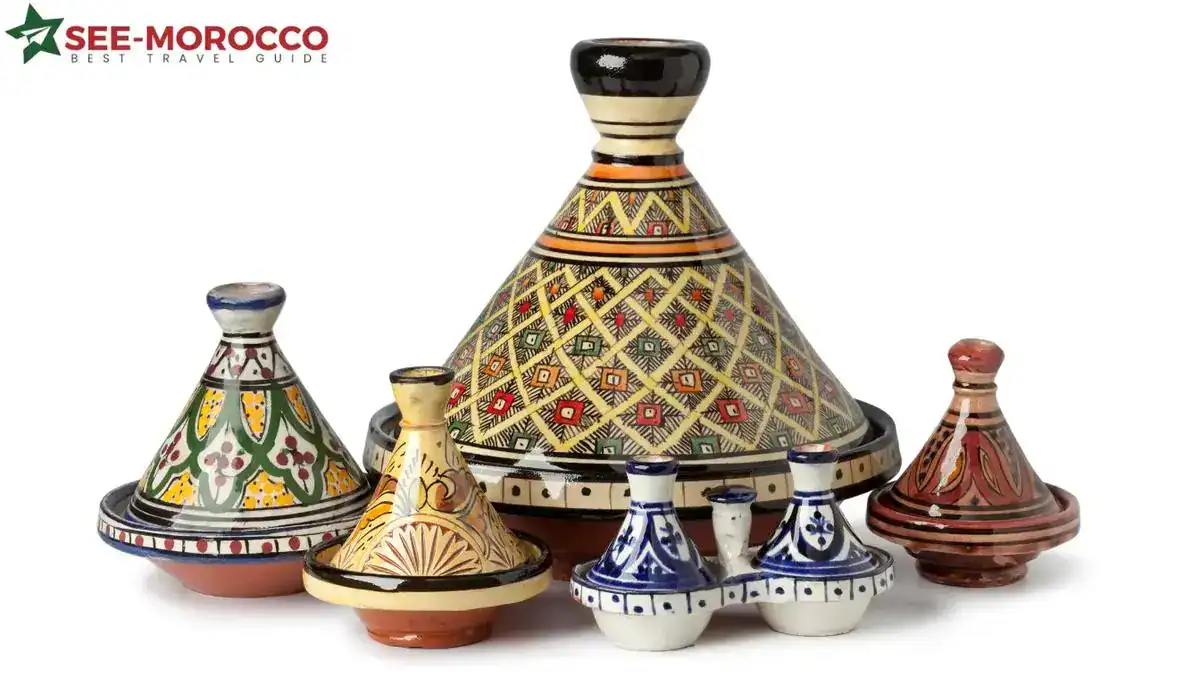
The question I get asked most often: how do I tell if pottery is handmade?
Turn the piece over. Wheel-thrown pottery has concentric spiral marks on the interior base — subtle but visible. Hand-built pottery shows different marks. Both are genuinely handmade; both are distinct from mould-cast pottery, which has a perfectly smooth interior with no tool marks.
Look at the glaze. In high-quality Moroccan faience, the glaze is applied by hand and shows slight variations in thickness. Where glaze pools in concave areas and thins over edges and ridges, it’s been applied by brush or dipping. Uniform, perfectly even glaze suggests spraying or industrial application.
The weight test: genuine earthenware (the clay most Moroccan pottery uses) is heavier than you expect for its size. Pick it up before you assess the price.
Cracks and crazing in old glaze are signs of age, not defects — and they’re signs that distinguish genuinely old pieces from artificially aged reproductions.
How to Buy Moroccan Pottery Without Regret
The pottery souks in Fes and Marrakech can be overwhelming. A few practical guidelines:
Don’t buy the first thing you like. Walk the whole souk first to calibrate prices and quality. Prices vary significantly for similar quality across different stalls.
Ask where the piece is from. A seller who knows their pottery can tell you whether a piece is from Fes, Safi, or elsewhere. Vague answers (“from Morocco” or “from the craftsmen”) are a yellow flag.
For significant pieces, bargain respectfully. Moroccan pottery is not priced fairly in tourist markets. As with rugs, the opening price in tourist areas is often two to four times what the seller will accept. This isn’t dishonest — it’s the established commercial ritual. Meet it with calm counter-offers rather than outrage.
Packing for travel: quality pottery sellers will wrap pieces for you. If you’re buying significant pieces, consider shipping separately — it’s often cheaper than paying airline excess baggage charges and safer than checked luggage.
The Craft Quarter Experience — Worth Doing Properly
If you want to understand Moroccan handicrafts rather than just buy them, visiting the craft quarters in Fes or Marrakech is revelatory.
In Fes, the pottery quarter (Ain Nokbi), the tanneries (Chouara), and the zellige workshops around the medina all allow visitors to watch production in progress. The tannery viewing terraces are the most famous (and smell the most memorable), but the zellige workshops are where I’d spend my time — watching a mallem cut tiles at speed is something that stays with you.
In Marrakech, the Artisan Centre near the royal palace has demonstrations of traditional crafts. It’s more curated than Fes but accessible and educational.
Practical note on “guided tours” to craft workshops: in both Fes and Marrakech, taxi drivers and unofficial guides frequently offer to take you to “free” craft workshops. These are not free — they’re commission-based retail operations. The craft demonstrations are often genuine, but you’ll be subjected to significant sales pressure. If you want to see authentic craft production without a sales agenda, hire a licensed guide through your accommodation who isn’t working on commission.
FAQ — Moroccan Handicrafts
How do I know if a Moroccan rug is handmade?
Check the back of the rug — genuine handwoven rugs have slight irregularities in knot pattern and the fringe is part of the warp structure, not sewn on. Machine-made rugs have perfectly uniform backs.
What’s the difference between zellige and regular Moroccan tiles?
Zellige is hand-cut geometric tile work assembled by a skilled craftsman (mallem) without any template. Each piece is unique and slightly irregular. “Moroccan-style” tiles are industrially produced with consistent dimensions and printed patterns.
Are Beni Ourain rugs and Berber rugs the same thing?
No. Beni Ourain is a specific tribal tradition from the Middle Atlas — undyed natural wool, geometric patterns, minimalist aesthetic. Berber is a broad cultural category encompassing dozens of weaving traditions across Morocco and North Africa.
What is tadelakt and is it durable?
Tadelakt is a burnished lime plaster technique that’s been used in Moroccan hammams for centuries. When applied correctly, it’s genuinely waterproof and durable. Poor application (by untrained craftsmen) can crack and fail. Ask to see examples of any craftsman’s previous work before commissioning.
Where is the best place to buy authentic Moroccan pottery?
Fes produces Morocco’s most sophisticated pottery (blue and white faience). Safi produces larger quantities at more accessible prices. Both cities’ craft quarters are better sources than tourist markets in Marrakech, where prices are higher and quality is more variable.
How much should I pay for a Moroccan rug?
This varies enormously by size, material, region, and quality. As a rough guide, recent souk prices for a small genuine handmade rug (60x90cm) start around 800–1,500 MAD. Medium tribal rugs (120x180cm) typically run 2,000-5,000 MAD in the souks. Beni Ourain rugs sit at the top of the market, and good examples often go well above 5,000 MAD. Everything in tourist markets is negotiable — the asking price is not the real price.
Is it legal to export Moroccan antiques?
Morocco has cultural heritage export restrictions. Genuine antiques and items of historical value need an export authorization from the Ministry of Culture. Ask the seller for the paperwork before you pay. Sellers who claim an item is antique but can’t provide documentation are either mistaken or misleading you. For contemporary craft pieces, there are no export restrictions.
What are the most authentic Moroccan handicrafts to bring home?
The most representative Moroccan handicrafts are handwoven Berber or Beni Ourain rugs, hand-cut zellige tiles, and Fes or Safi pottery. For something more portable, consider smaller pieces like tiled mirror frames, ceramic tagines, or kilim cushion covers — all genuine Moroccan handicrafts at travel-friendly sizes.
Questions about a specific piece you’re considering buying, or want advice on what to look for in a particular craft? Leave a comment — I try to answer every one.